R.P. Rivestimenti Plastici s.r.l.
Corso Alessandria, 3/2
10078 VENARIA (TO)
ITALY
Contact details
Quick links
R.P. Rivestimenti Plastici s.r.l. © 2023. All right reserved. P.IVA IT 05097550015. Capitale sociale 98.280,00 €. Numero REA TO 686387
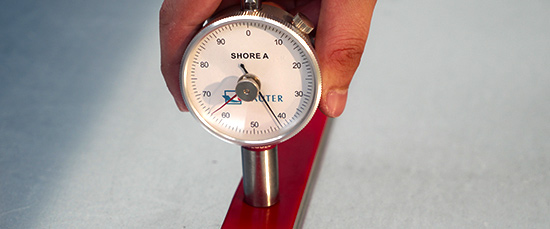
The hardness of a plastic material is a crucial parameter that directly affects its resistance to scratches, dents, and other forms of mechanical wear. The ability of a material to maintain its characteristics under stress is fundamental to determine its suitability in specific applications.
Vintech represents a significant step forward in the field of plastic coatings, offering custom solutions that meet a variety of industrial needs, while ensuring high and long-lasting performance.
As part of the continuous search for advanced solutions for long-lasting protective coatings, R.P. Rivestimenti Plastici s.r.l. has developed the Vintech compound in-house, a PVC designed for applications on metal substrates of various kinds.
This innovative material was the focus of an in-depth study conducted in collaboration with the Department of Materials Science and Chemical Engineering of the Politecnico in Turin. For this trial, R.P. Rivestimenti Plastici s.r.l. created and then made available seven different formulations of Vintech, each characterised by a different plasticizer content and with a hardness measured in Shore A ranging from 30 to 90Sh.
This study allowed us to examine how variations in hardness affect the performance of coatings, showing Vintech’s extreme versatility and adaptability to a variety of industrial needs.
The hardness of a plastic material is a measure of its resistance to permanent deformation under the application of a force over a given period of time. This parameter is fundamental to determine the ability of the material to resist scratches, dents, penetrations and other forms of mechanical wear to which the items are notoriously subject.
Hardness is a crucial factor in the selection of plastic materials for specific applications. For example, in applications where materials must resist scratches and abrasions, such as coatings or machine parts, where greater hardness is preferable. On the other hand, less hard plastic materials may be more suitable for applications where a certain flexibility and shock absorption capacity is required, or again, vibration and noise reduction.
Therefore, the hardness of a plastic material provides key indications about its softness and performance in everyday use situations, directly influencing the choice of material for specific engineering and industrial applications.
As hardness is a particularly significant parameter affecting the performance and suitability of applications, there are reference standards relating to the methods and criteria used to measure this property in elastomeric materials, such as rubbers, plastomers and polymers.
The use of reference hardness standards is crucial for several reasons:
Comparability: they allow direct comparison between the hardness of different materials.
Reliability: they provide consistent and reproducible measurements.
Selection of materials: they help engineers and designers in choosing the suitable material for specific applications based on deformation resistance requirements.
Hardness is usually assessed using different standardised tests, which vary depending on the type of material and the specific application.
Some of the most common methods for measuring the hardness of plastics include:
Shore Hardness Scale: the Shore hardness scale is commonly used for elastomers and some thermoplastic polymers.
It measures the penetration depth of a standard penetrator applied directly to the sample. There are two main types of Shore tests:
Shore A: used for softer materials such as rubber and flexible plastic. The test uses a durometer with a blunt conical tip that penetrates the material on a surface no less than 8/10 millimetres.
Shore D: used for harder materials such as rigid plastics. This test uses a durometer with a sharper conical tip.
The result is expressed on a scale from 0 to 100 Sh.A, where a higher number indicates greater hardness.
The harder the product is considered, the greater its ability to resist wear.
This is especially true for harder PVC, which offers several significant advantages. First of all, it’s extremely resistant to impacts and scratches, making it ideal for applications where high durability is required. Moreover, the hardest PVC maintains its shape and functionality even under extreme environmental conditions, guaranteeing a long life over time. Finally, it requires little maintenance, making it a cost-effective and efficient choice for multiple uses.
Rockwell Hardness Scale: The Rockwell Hardness Test is most commonly used for metals, but some of its variants are also used for plastics. Rockwell hardness is measured in different scales, for example:
Rockwell R: used for softer plastic materials.
Rockwell L and M: used for harder plastics.
The test measures the depth of penetration of a penetrator under a pre-set load.
Vickers Hardness Scale: The Vickers Hardness Test can also be used for some rigid plastics. This method uses a diamond pyramid penetrator and measures hardness by calculating the surface area of the imprint left by the penetrator. Vickers hardness is expressed in kilogram-force per square millimetre (kgf/mm²).
Brinell Hardness Scale: the Brinell hardness test, similarly to the Vickers one, is most commonly used for metals, but can be adapted for some rigid plastics. It uses a steel ball or tungsten carbide to penetrate the material under a pre-set load, and the hardness is calculated based on the footprint size.
MARCATURA CE - ISTITUTO GIORDANO
Declaration of Conformity (or Performance for construction products). The product is globally and fully compliant with the requirements of the EU in terms of safety, health and environmental protection.
QUALITY MANAGEMENT SYSTEM
The company operates in compliance with the requirements of international quality standards regarding the management of production processes and customer satisfaction.
MANAGEMENT SYSTEM FOR THE ENVIRONMENT
The company proactively manages and monitors its environmental impact by committing to pollution prevention, legal compliance and ongoing improvement.
LEGALITY RATING
It certifies compliance with high standards of legality and ethical business suitability (Law no. 29 of 24 March 2012, Competition and Market Authority (AGCM) in conjunction with the Ministries of Justice and the Interior).
WRAS
- UK water industry approval system - certifies that the chemical anchor, once hardened, is suitable for contact with water for domestic use.

CAM FRIENDLY
Minimum environmental criteria.

KIWA<br/certifies that the coating systems comply with the Kiwa BRL-K759 "Coating systems for drinking water applications" evaluation guidelines.
RILSAN®
ARKEMA
Certified applicators.
Corso Alessandria, 3/2
10078 VENARIA (TO)
ITALY
R.P. Rivestimenti Plastici s.r.l. © 2023. All right reserved. P.IVA IT 05097550015. Capitale sociale 98.280,00 €. Numero REA TO 686387