Packaging and environmental pollution: is plastic to be blamed?

Strisce protettive e bandelle antiscivolo per trasporti

Increasing awareness of the environmental damage of packaging, especially plastic, leads the modern era to question its use: is plastic to be blamed? This question brings to the forefront a complex discussion about balancing the practical benefits and the environmental impact of plastic in the packaging industry, which unfortunately represents one of its primary areas of use.

While plastic offers versatility and functionality, concerns about environmental damage and human health continue to grow. However, some companies, like ours, are looking for solutions to reduce their environmental impact without compromising efficiency.

Our contribution, through Vintech-PVC and other innovations, aims to promote a more sustainable future and the proper use of plastic materials.

Different types of packaging

Various forms of packaging are intended to protect and contain goods, from raw materials to finished products.

These forms of packaging mainly fall into three categories:

  • Primary packaging: refers to the type of packaging that is designed to be the unit of sale for the end consumer. These include, for example, the containers that come directly into contact with the product and are sold as a single unit at the point of sale.
  • Secondary packaging: groups together multiple sales units and can be used for direct consumer sales or to facilitate shelf replenishment It is removable without affecting the characteristics of the product and serves to protect primary packaging during transport or to promote sales.
  • Tertiary packaging: it is designed to facilitate the handling and transport of various sales units or multiple packaging, protecting them from damage during transport.
Plastic packaging

When and how can we understand that an object, even if made of plastic, has a positive or negative impact?

Plastics are widely used due to their versatility and affordability compared to other materials, but there are growing concerns about the negative environmental impacts they generate if not used correctly. Hence the question about its use. Indeed, due to these characteristics, plastics are increasingly replacing other packaging materials such as paper and wood.

Between 2000 and 2015, the share of plastic packaging in global volume increased from 17% to 25%, driven by strong growth in the global plastic packaging market of 5% per year.
In 2013, the industry placed 78 million tons of plastic packaging on the market, with a total value of $260 billion.
Today, 95% of the value of plastic packaging materials, amounting to $80-120 billion per year, is lost to the economy after a short initial use; this is the primary cause of its waste.

The recycling rate of plastics in general is even lower than plastic packaging: both are well below the overall recycling rates for paper (58%) and iron and steel (70-90%).
More than 40 years after the launch of the well-known recycling symbol, only 14% of plastic packaging is collected for recycling, another 14% is sent for incineration and/or energy recovery.
A large percentage (72%) of plastic packaging is not recovered at all: 40% is disposed of in landfills, and 32% escapes the collection system, meaning it is either not collected at all, or it is collected but then disposed of illegally or mismanaged.

The externalities related to the use of plastics and plastic packaging mainly fall into three main areas: degradation of natural systems due to waste, especially in the ocean; greenhouse gas emissions from production and incineration after use; and impacts on health and the environment due to hazardous substances.
Plastic waste, especially in the ocean, are a serious problem, with about 8 million tons ending up in the sea every year. If no action is taken, this is expected to double by 2030 and quadruple by 2050.

Plastic packaging is one of the main sources of this waste, accounting for over 62% of the items collected during coastal cleanups.
This waste harms marine ecosystems and causes significant economic costs, estimated in billions of dollars, affecting, in particular, the tourism, fishing, and transport industries.

Consequences include impacts on human health, food chains and the environment.

Is plastic to be blamed?

Due to their combination of unbeatable characteristics and low cost, plastics are the basic material of the modern economy, especially in the poorest and/or underdeveloped countries where price still matters a lot compared to the quality of the good.

Their employment has increased twenty-fold in the last half century and is expected to double again in the next 20 years.

Currently, practically everyone, everywhere in the world, comes into contact with plastics every day, in particular with plastic packaging that has been cleared by multinationals before and is now within everyone’s reach.

First, plastic packaging is not only a cost-effective option, but also performs a number of crucial functions. By preventing the spread of waste, protecting against damage, and ensuring the preservation of products, it helps to preserve the quality of items and reduce waste.

 Plastic is remarkably versatile and durable. Compared to materials such as glass and metal, it is less prone to breakage and can be easily sealed, offering protection against contamination.

Its lightness makes it ideal for applications that require weight reduction and greater efficiency, such as in the automotive sector, allowing for significant fuel savings and reducing CO2 emissions.

Moreover, the production of plastic requires less energy and resources than other materials, which contributes to limit air pollution and the consumption of natural resources.

It is important to recognise that, if managed correctly, plastic can be an ally in the fight against waste and in the optimisation of resources. In addition, the fact that it is recyclable offers opportunities for a second life.

While it’s true that plastic has caused considerable environmental problems, it’s important to consider that totally condemning plastic may not be the best solution. Instead, it might be more effective to try to find ways to more sustainably manage plastic use and develop alternatives that are less harmful to the environment. This approach could allow us to balance the practical benefits of plastic with the need to protect the environment.

The circular economy is fundamental if we want to tackle plastic pollution and generate significant economic, social and climate benefits.

By 2040, this economy could dramatically reduce the volume of plastic ending up in our oceans, cut greenhouse gas emissions and create additional jobs.

To achieve this vision, action is required on three fronts: eliminating problematic and unnecessary plastic items , innovating to make plastic reusable, recyclable, or compostable, and ensuring that plastic products remain in the economy and out of the environment through circularity

However, global rules are needed to stimulate investment and innovation, as well as promote a level playing field and drive change.

A UN plastics treaty based on legally binding global rules and global circular economy measures could accelerate systems change and prevent plastic pollution. It is essential to agree on mandatory extended producer responsibility policies to ensure that all industry operators contribute to the collection and treatment of plastic packaging.
Our contribution

In line with the importance of tackling and managing plastic pollution in order to promote sustainable development, as a company we are committed to finding solutions that reduce our environmental impact without compromising the efficiency and reliability of our operations.

Aware of the importance of plastic in industry, especially in the transport and packaging sectors, we try to combine this need with a responsible approach.

Based on solutions adaptable to a wide range of structures and equipment, we use Vintech-PVC, a material suitable for coating or being mounted on different surfaces.

Vintech-PVC offers practically unlimited options and opportunities, which deserve a scrupulous evaluation. In the industrial field, for example, the use of plastic materials for the coating of metals is decidedly advantageous and economically convenient.

This approach allows the reuse of the good or metal material without having to reproduce it completely, resulting in significant savings in the long run.

Basically, if plastic were used more in combination with metal, this would be the best solution, both in financial and environmental terms.

The use of objects produced exclusively in plastic or disposable, due to the ease of dispersion and breakage of the article itself, is the main problem and the reason why today we blame materials that, if used correctly, would represent an investment and not a waste.

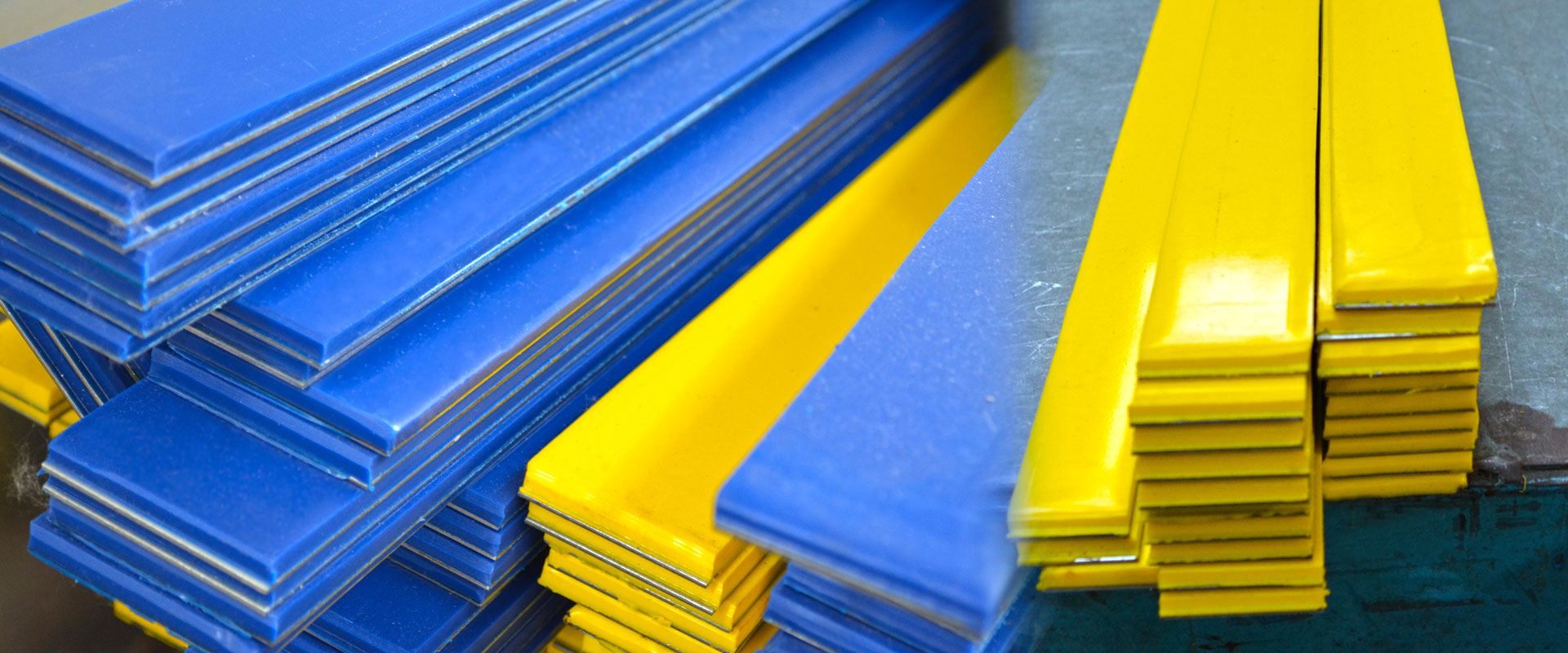
Our Vintech protective strips, consisting of a soft PVC layer combined with a flexible metal base and of variable thickness, are designed to protect goods during transport effectively as they are reusable and recyclable. Contrary to classic disposable packaging and materials, they contribute to reducing the environmental impact associated with the production and disposal of materials.

Our commitment to the environment is not only limited to the protection of products during transport, but also extends to the protection of natural resources and the reduction of waste.
Our commitment to a more sustainable future is reflected in every aspect of our operations, thus contributing to a cleaner and greener world for us and especially for future generations.